
Volkswagen, a long-standing but minor player in India's fiercely competitive automotive sector, is now exploring a strategic partnership with the JSW group, aiming to revitalise its market presence, enhance profitability, and potentially establish India as a key export hub for electric vehicles.

Almost 30 per cent of Maruti's auto-component exports are to the US, and about half of that is facing a duty of 25 per cent and the other half 50 per cent.
With Maruti Suzuki refusing to go back on the plan, these investors have approached the Securities and Exchange Board of India, which is examining the possibility of taking action under Section 11 of the Sebi Act.

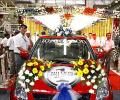
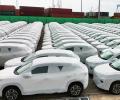
Maruti Suzuki India on Tuesday said it has commenced export of its sports utility vehicle Fronx to Japan. The first consignment of over 1,600 vehicles left for Japan from Gujarat's Pipavav port, the country's largest carmaker said in a statement. Fronx will be the first SUV from Maruti Suzuki stable to be launched in Japan, it added.

In terms of safety, the Victoris has scored 5 stars in both GNCAP and BNCAP tests and that's a first for Maruti, observes Somnath Chatterjee.
The company said its cost reduction and localisation initiatives, growth in volumes and favourable foreign exchange helped improve the bottomline during the quarter.

Nearly 50 per cent of the stocks that comprise the Nifty 50 are trading below their respective 200-DMAs.

Net sales of the company for the fiscal stood at Rs 48,605.53 crore.

Car sales in the quarter were up 3.9 per cent at 3,60,402 units, the company said, adding that the exports were at 27,009 units.

In the next 36 months nearly 25 to 40 per cent of jobs will be under threat from AI and job losses are inevitable.
"My understanding is that the rules are weighted in favour of big cars, even though smaller cars emit fewer emissions per passenger, use less material, and consume less fuel," Bhargava said in an interview with Business Standard.

Net sales during the reported quarter rose to Rs 20,594.3 crore, up 14.4 per cent against the year-ago period.

The country's largest carmaker Maruti Suzuki India expects auto sales to bounce back to the glory days of 7 per cent growth by FY 27, helped by the proposed GST rate cut which is expected to bring down car prices by 3.5 to 8.5 per cent.

Indian benchmark indices Sensex and Nifty rallied in early trade, driven by a significant decline in crude oil prices and positive developments on the geopolitical front, alongside strong performance in blue-chip IT stocks. Track Sensex, Nifty on July 2, 2026

Net sales, however, rose marginally to Rs 21,551.9 crore for the quarter under review

The domestic car market leader said there will be no cash outflow from MSI as the merger is proposed to be effected through a share swap agreement.

MSI sold 3,21,898 units of vehicles during Q2, a growth of 16.80 per cent, compared with 2,75,586 units in the corresponding year-ago period.

VinFast has gone from an unknown brand to India's fifth-largest EV carmaker in just seven months, but its toughest battle is only beginning.
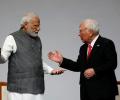
Osamu Suzuki, the man who took a risk and bet on India when no one else believed in having a viable automobile company in the country, has died at the age of 94, according to information shared by Japan's Suzuki Motor Corporation on Friday.

Indian benchmark indices, Sensex and Nifty, experienced a significant drop of over 1 per cent, driven by a bearish trend in global markets, weakness in HDFC Bank and IT firms, and fresh foreign fund outflows.

Divya Ganesh takes home Rs 50 lakh as well as a Maruti Suzuki Victoris.

Maruti Suzuki India (MSI) on Wednesday reported over two-fold jump in its consolidated net profit to Rs 1,036 crore for the first quarter ended June 30, mainly due to a low base in the year-ago period. The auto major had posted a net profit of Rs 475 crore in the COVID-hit April-June quarter of the last fiscal. Its net sales rose to Rs 26,512 crore in the June quarter compared to Rs 17,776 crore in the same period of 2021-22.
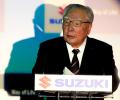
'Without his vision and foresight, his willingness to take a risk that no one else was willing to take, his deep and abiding love for India, the Indian automobile industry could not have become the powerhouse that it has become.'

Amid challenging market environment, Maruti Suzuki India and Mahindra & Mahindra reported an increase in vehicle dispatches to dealers last month while Tata Motors and Hyundai saw a year-on-year drop in sales.

Benchmark equity indices Sensex and Nifty extended their gains for the second straight session on Monday, driven by optimism over the India-US trade deal and robust buying in public sector banks, consumer durables, and realty stocks.

With features usually seen in more expensive cars and segment-first paddle shifters, the Tiago offers excellent value for money, says Rajesh Alva/Rediff.com.

Indian benchmark indices Sensex and Nifty closed higher, with the Sensex climbing 355.90 points, driven by positive state election results and better-than-expected Q4 earnings, despite ongoing geopolitical concerns.

The quarter was marked by adverse foreign exchange rates and commodity prices, higher depreciation and higher sales promotion expenses.

History may remember Takaichi Sanae not as the leader who simply accelerated Japanese rearmament, but as one who governed during Japan's transition from an industrial-age security model to a post-industrial strategic member of the global order, points out Varun Arya.

Suzuki, who is in India on a visit, told representatives of Maruti Udyog Kamgar Union, the elected union of Maruti Suzuki India that the management of the Indian arm would not accept any indiscipline in the company.
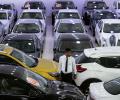
Leading automakers Maruti Suzuki, Tata Motors, Mahindra & Mahindra, and Hyundai Motor India posted higher sales in January riding on the growth momentum ushered in by the GST reforms in the festive period last year.
Singh's humility and grounded nature were highlighted in a heartfelt social media memoir by Uttar Pradesh Minister of State for Social Welfare (Independent Charge) Asim Arun.

Most of the engines used by Suzuki's two-wheelers in India are manufactured by Maruti at its Manesar plant.

Sales of Maruti Suzuki India during January-December 2008 stood at 697,850 units while those of Suzuki Motor Corporation for the same period stood at 679,215 units. The comparable growth for MSIL in India comes on the back of an almost 2 per cent decline for the company in a year-on-year basis during the calendar year. Its sales were higher in calender year 2007 at 710,532 units, according to the data provided by the company.

Maruti Suzuki, India's largest producer of small cars, stands to benefit the most.

Indian equity benchmarks Sensex and Nifty surged nearly 1 per cent, driven by strong earnings reports from FMCG and auto sectors, alongside a rally in Asian markets and signs of de-escalation in geopolitical tensions.

Maruti Suzuki India on Tuesday said it has increased prices of its entire model range with immediate effect. An estimated weighted average of increase across models is 0.45 per cent, the auto major said in a regulatory filing.

Maruti Suzuki India on Thursday said the locally manufactured Jimny five-door model has made its debut in the Japanese market. The SUV, which is exclusively manufactured at Maruti Suzuki's Gurugram-based plant, was unveiled in Japan on Thursday.

Sensex gains over 400 points while Nifty trades above 23,800 amid strong IT sector buying.
A day before US President Donald Trump's additional 25 per cent tariff kicks in, Prime Minister Narendra Modi on Tuesday made a vehement pitch for swadeshi and Make in India that should help create jobs in the country.
